Is AI The Ultra-Processed Food of the Tech World? with Geosolv CEO, John Schroeder
Those of you who know me well will know that I’m often the first to turn to various AI tools to complete a job, dependent on the need to gain “efficiency” and maximize my time. I’ll tell myself that these tools help me get more done in a shorter timeframe, thus allowing me to spend more time interacting with colleagues, clients, and even... not working. The convenience that AI markets is true. It does give us more time back – but at what cost?
As a new year begins, people usually spend time reflecting on the previous year and considering what they want to change moving forward. Whether that be a New Year’s resolution – according to a commercial I saw while watching football this weekend, most people have quit by January 9th – or just a general “I need to [insert whatever your thing is here].”
I’m not immune to this goal setting, by any means. Like many other people, my goals this year are around health and making sure that I’m becoming the best version of myself. I’m proud to say that I’m still working out and feeling very sore.
I’ve realized that it's clear to see a connection between exercise and diet – the more you work out, the more likely you’re concerned with what you eat. For example, if I’m putting in the time and effort to work out, I don’treally want to waste it on an Oreo. Maybe you would, but I wouldn’t. I would waste it on a slice of pizza, though.
Pizza is my kryptonite.
Okay – you're maybe wondering, “What’s the point of all of this? This guy is just rambling.”
If you know me, you know that’s just who I really am.
Back to AI.
So, during my workout (you see how I’m connecting the dots here?) I was thinking – are we entering an era that we will regret in 50 years? Will we see this time as a moment in history that directly points to cognitive decline?
Don’t click out of the article yet. I know how this sounds and I know what you might be thinking – Come on! You’re crazy. Don’t be a tech hater. Hear me out, here. I’m not a tech hater. In fact, I’ve built my career on leveraging technology and applying it where others don’t.
But we have to ask ourselves – what is the cost? Will there come a day where people are unable to communicate simple answers, unable to hold basic conversations because these tools have done it for us? Has that day already come?
As I was mulling over this concept during my workout, I thought of the release of the United States new food pyramid. It prioritizes whole foods – meat, cheese, and vegetables at the top – and calls for a significant reduction in highly processed foods. It made me wonder – what the timeline was like for the mainstreaming of processed foods, and why did society think it was a good idea? I’m convinced that if we knew then what we know now, we would’ve made different choices.
With a little old-school Google research,
I was able to put together a timeline with some of the major milestones in the processed food movement.
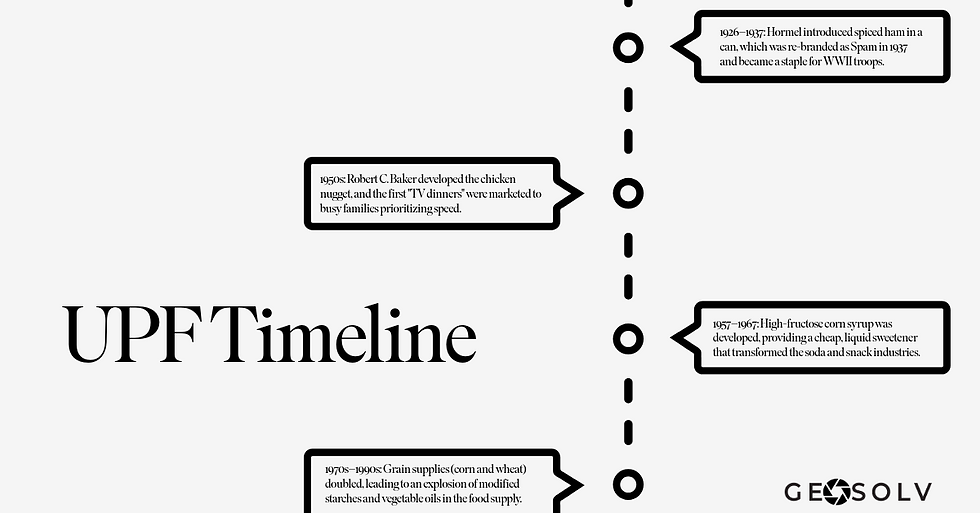
Continued research through 2026 identifies dozens of adverse side effects linked to processed foods, particularly ultra-processed foods (UPFs). These foods are industrially formulated to be hyper-palatable but often lack necessary nutrients.


Like I said, I’m convinced that if we knew then what we know now, things wouldn’t have turned out this way. So how did they turn out this way?
Well, this is where the power of marketing comes into the picture. With convincing messages that promised a new and better way of life, these UPF manufacturing companies were able to make sale after sale, eventually shifting the diet of the entire American population.


Don’t these messages feel a little familiar to you? The promise of speed, convenience, and the push to just keep up with a changing society—these are the same things that AI promises us now.
And—it works.
This focus on speed and efficiency in the 1950s successfully reduced the time spent on food preparation and cleanup from several hours a day to an average of just 39 minutes per day at the end of the 21st century. This “liberation” came at a cost, though—the cost of nutritional quality, as industrial processes used to stabilize these foods often rely on high levels of fat, sodium, and preservatives.
What’s the big deal?
We live in an instant gratification world and are driven, now even more than in the ‘50s, to produce more in less time, with less people. As I’ve reflected on the cost of this same shift in the food industry, I wonder what the cost of this widespread usage of AI will be? What might we look back on and regret? Could ChatGPT be the new SPAM of our generation? Are we creating an epidemic for future generations, one that will require correction from administration?
I don’t know.
The reality is that these tools, just like SPAM, aren’t going away. And, while I’m not a SPAM eater, I think they have their place.
AI helps people be more efficient, allowing them to go to a ball game, dance recital, a meal with a friend, or just get a project done when understaffed. Having tools like these in our toolbox—an option to be used at the right time and for the right purposes, and with a good understanding of how the tool works—is a good thing. It does make our lives easier.
I will continue to use AI tools to create, review, and polish work. I think it would be foolish to ignore the benefits and usefulness of certain AI tools. It would be just as foolish, though, to let AI replace my own thinkingentirely. It needs to be balanced with continual learning, reading, and appropriate boundaries.


Comments